
What Washington County Deed Types Convey
The Recorder's menu lists deeds alongside mortgages, releases, reconveyances, plats, liens, and affidavits. A label names the recorded form. Legal effect depends on the whole instrument.
| Deed Type | What It Does | Common Use |
|---|---|---|
| Warranty deed | Conveys the stated interest with covenants | Conventional sales |
| Quitclaim deed | Conveys whatever interest the grantor holds | Family or title cleanup |
| Grant / special warranty | Uses limited covenants | Selected transfers |
| Trustee / executor deed | Conveyance through a trust or estate role | Probate or trust administration |
| Tax deed | Transfer after statutory tax process | Delinquent-tax property |
A deed transfers an interest in land. A mortgage or lien, by contrast, usually records an encumbrance against it. Search releases and reconveyances on their own, because an original filing will not show whether the debt was later satisfied.
Search the Washington County Recorder Fields
The Recorded Documents Search takes an instrument number. It also accepts a document type, name, description, or a date pair. At least one criterion is required. An instrument number overrides the other fields, and document type cannot stand alone. For names, pair a surname with a first-name fragment. Keep any subdivision or section text in Description brief.
| Field | Best method | Caution |
|---|---|---|
| Name | Last, First fragment | Try variants |
| Description | Short place clue | Avoid over-specifying |
| Instrument | Exact number | Overrides all others |
| Date | Start/end pair | Recording and signing dates differ |
BK11/PG328 Bridges Old and New Indexing
One deed dated August 24, 1901 appears online as instrument 5001068, carrying the old reference BK11/PG328. Its detail page lists transaction type, page count, dates, the legal description, party roles, and image status. That is the bridge between old book-and-page indexing and the modern system. It proves a 1901 example is reachable, not full coverage from that year. The sample deed detail shows the crossover in one record.
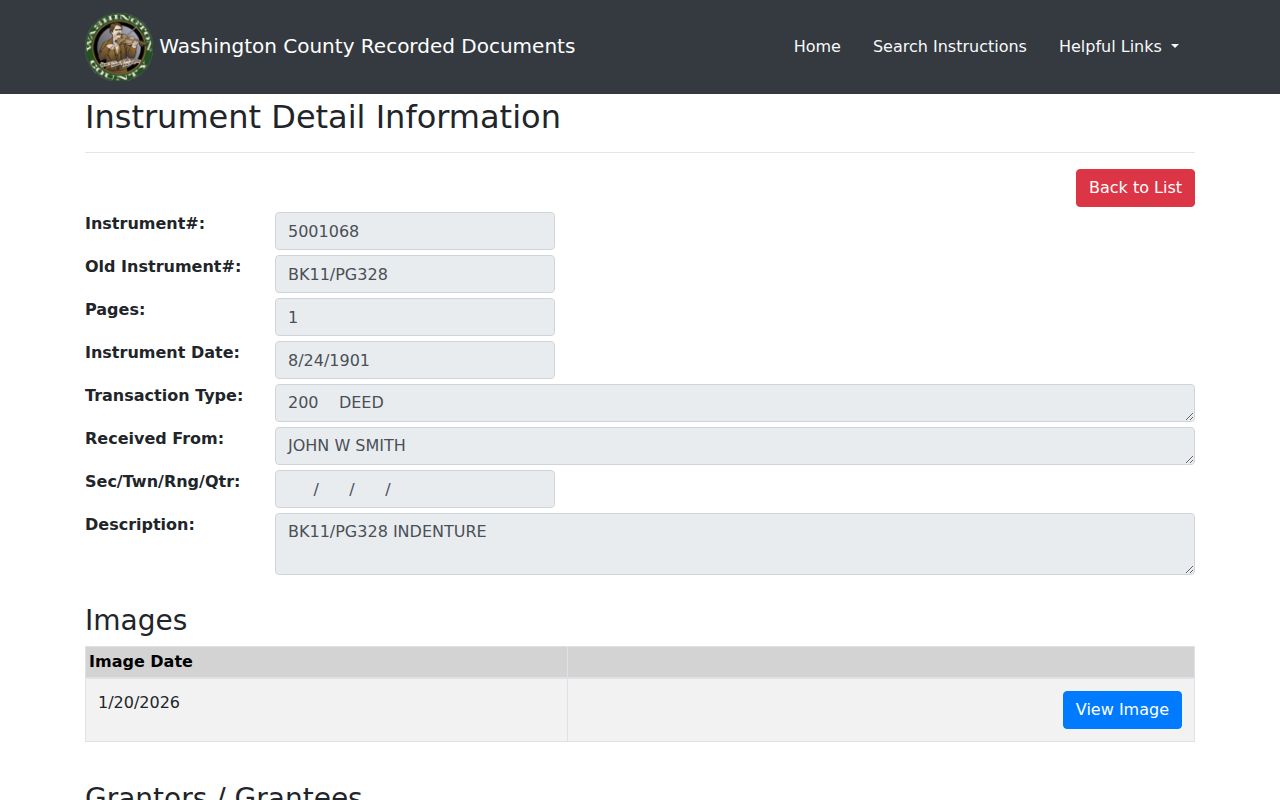
Keep both references for office or archive follow-up.
Walk Washington County’s Grantor-Grantee Chain
The grantor conveys the stated interest; the grantee receives it. Begin with the most recent acquisition you know, then work backward, repeating the name handoff while checking that each legal description matches.
- Find the newest acquisition with the owner as grantee
- Read the grantor and land description
- Search that grantor as an earlier grantee and match the land
- Repeat through book-page and office records where the online chain thins
- Grantor
- Party transferring the stated interest.
- Grantee
- Party receiving the stated interest.
- Chain of title
- Ordered sequence of instruments affecting land.
- Book/Page vs Instrument #
- Older volume reference and modern indexed identifier.
Legal Descriptions Outlast Street Clues
One Fruitvale record pairs 1023 State Street with Lots 7-8, Block 14 and PIN RPW0400014007A. A Watkins record joins 305 E 12th Street to Lots 7-8, Block 10. The same deed carries a railway right-of-way exception. It also lists manufactured-home parcel MH009585. The street address is just the label. When both appear, search the real property and manufactured-home records separately.
The 1938 Courthouse Fire Raises a Provenance Question
The 1888 courthouse burned in 1938. A WPA replacement opened in 1939. Which deed books or indexes were lost, survived, reconstructed, or reindexed is not established, so ask the Recorder or the Idaho State Archives rather than assuming either total loss or continuity. The 1901 online result stands as one confirmed example, nothing more.
Planning May Require Deeds Back to 1979
County Planning & Zoning stopped performing deed searches in 2021. Permit and land-split inquiries now require a contiguous original-parcel chain. That chain must reach back through April 9, 1979. Build the chain through the Recorder, then follow the planning instructions. This administrative requirement is separate from any title opinion.
Separate Deeds from Court and Probate Files
A recorded deed shows what instrument entered the public land-record index. It does not open the courtroom. Foreclosures, quiet-title disputes, lien enforcement, and probate administrations each generate separate case files. Search statewide iCourt for case information. Then inspect a courthouse kiosk or request the file from the clerk where it was filed. Pleadings explain the dispute and the authority granted. The Recorder index tells you whether the resulting deed, judgment, or notice was recorded against the land.
Estate transfers interrupt a clean seller-to-buyer pattern more than anything else. A personal representative, trustee, decree, or affidavit can explain the next grantee change. It may show why the next indexed grantee differs from the prior owner of record. Match names, dates, document types, and legal descriptions. Do not skip over the court or probate bridge.
Use Plats and Affidavits to Follow Changed Land
Splits and subdivision changes can make one modern PIN a poor key. It often fits older Washington County deed records badly. Recorded plats define the lots and blocks. Affidavits can clarify or amend plat information. Section-township-range fields tie rural instruments to Public Land Survey geography. Search the Recorder with a short subdivision name, then compare the document detail against county assessment maps.
A 1977 Holmes Subdivision plat-change affidavit is one confirmed example of a document that adds land-description context. It does not function as a conventional sale deed. When the chain seems to jump, check plats and boundary-related affidavits. Also check probate filings and predecessor parcel descriptions before concluding a deed is missing.
Verify Every Link in the Deed Chain
A sound deed chronology records far more than names. For each instrument, capture the recording date, instrument date, document type, and instrument number. Add the old book and page when shown, grantor, grantee, legal description, and image status. Compare the land language at every step. Similar names do not prove two entries concern the same person. A repeated owner name does not prove the parcel is the same. Lot-block and section-township-range clues guard the chain against those false joins.
Search beyond documents labeled simply "deed." A reconveyance or release may clear a recorded security interest. A plat or affidavit may explain a changed description. Probate or court records may supply the authority behind an estate transfer. Tax-deed proceedings and commissioner minutes can document a statutory route. Yet a notice is not the final recorded conveyance. The Recorder index remains the place to confirm the result. It shows whether the resulting instrument entered the county land record.
Historic chains deserve a provenance note. Record exactly what the online database demonstrates. Then ask which physical book, microfilm roll, reconstructed index, or archival series holds the earlier portion. The courthouse fire makes that question pressing without answering it. Idaho State Historical Society indexes, the 1904 D. A. Utter map, regional directories, and newspaper microfilm can corroborate names and land context. But none belongs in the chain as a substitute deed.
Order or Inspect a Washington County Deed
Ordering a copy starts with the Clerk / Auditor / Recorder at 256 E Court Street in Weiser. You can also call 208-414-2092. Copies run $1 per page. The Recorder wants payment up front. Nothing goes out by email until it is paid. Have the details ready. Give the instrument number, the book and page, and the names on the deed. Include the date and the legal description. Certification is a separate request. Ask about it on its own.
The official Recorder page lays out the current copy route. If no image is online, you can still inspect records in person. You can also file a focused records request with the office.
Recorded, not guaranteed. The index shows accepted and indexed instruments; it is not a title opinion, and unrecorded interests or indexing gaps may exist.
When you cite a Washington County deed, quote the recorded instrument itself. An index summary is a discovery tool, not the final word. Index fields help you find the deed records fast. Yet abbreviations and party-role conventions can flatten what the document actually says. The recorded deed governs its own language, signatures, acknowledgments, exceptions, reservations, and legal description. So it stays the authoritative source for any conclusion about the parcel.