
Trace Washington County Former Property Owners
Former owners of Washington County land are rebuilt from transfers, not from one current parcel card. Begin with the newest deed on the land. Read its grantor, then locate the older deed by which that same grantor once took title to the identical legal description. Use the county's public Recorded Documents index first. It names no starting year. Yet deeds recorded as early as 1901 sit in its deed records, so treat that as evidence of reach rather than proof that every year or image is complete.
| Source | Years It Covers | Where Held | What It Shows |
|---|---|---|---|
| Recorded Documents index | At least 1901 observed; full span unstated | Washington County Recorder online | Grantor, grantee, date, type and description |
| Deed books and old references | Confirm volume by volume | Recorder counter and record copies | Earlier conveyances keyed by book and page |
| Recorded plats and surveys | Varies by filing | Recorder index and county map catalog | Subdivision, lot, block and survey context |
| Historic maps and indexes | Collection-dependent | Idaho State Historical Society | Names and land-use context when the deed trail is hard to read |
Most recent chains start with a computer lookup. When an index entry shows an old book and page reference, copy both numbers. Step no further back until you have them written down. For older or murkier eras, contact the Recorder. Ask whether the index, book, image, or reconstructed series you need can be viewed at the counter. Historical maps may enrich a house-history project, yet a conveyance remains the evidence that matters.
A 1901 Washington County Deed Bridges Two Index Eras
Instrument 5001068 shows why modern and old references both matter when you hunt for previous owners. The online detail calls it a 200 DEED dated August 24, 1901. It keeps the BK11/PG328 citation. Kimberlin, John appears as grantor and Smith, John W as grantee, with a modern image date and a View Image link sitting next to the older reference.
The official sample deed detail appears below. It shows how a computer record can point back into a bound-book system. It preserves the party roles you need for the next backward search.
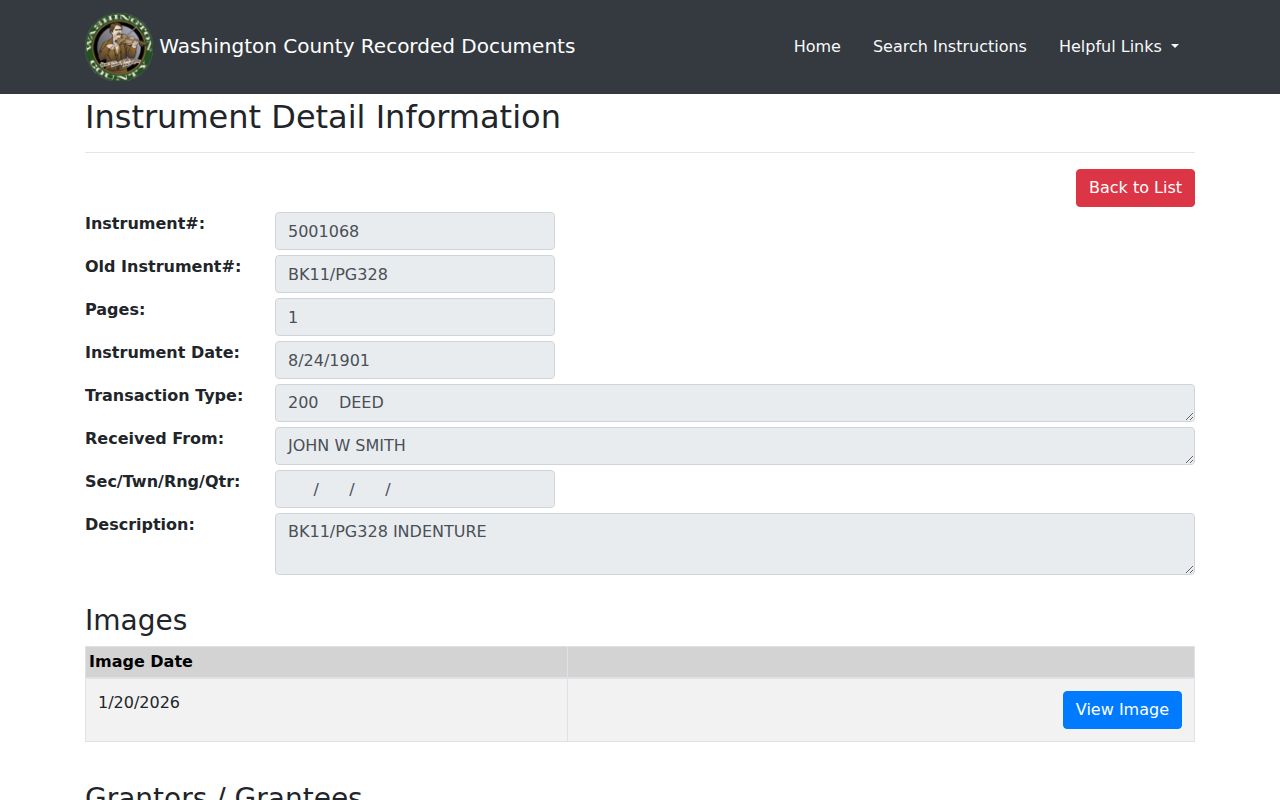
Copy every number, date, party, and description before leaving.
Search Washington County Prior Owners by Name and Description
The Recorder takes an instrument number, a party name, a description, or a paired date range. Enter names last-name-first, and add part of the first name when a surname is common. For descriptions, a short subdivision name or section term works best. Every term you enter must match, and the document-type filter cannot stand alone.
Instrument number is the exception: it overrides every other criterion. That quirk explains why a search came back oddly broad or narrow. Results list instrument number, recorded date, pages, received-from name, associated name, document type, and description. Read those fields carefully. Confirm the result concerns the same land before counting the party among the former owners.
Note: A name match alone proves little. Without the same legal description and transfer sequence, it does not place that person in this property's chain.
Walk the Washington County Deed Chain in Reverse
The backward method follows roles, not guesses. Start with the deed that vested the current grantee, then make its grantor your next search subject. Keep the parcel's legal description beside the names, because addresses and indexed spellings shift over time.
- Find the current acquisition deed and verify that its legal description matches the subject parcel.
- Record the grantor, who was the prior owner named in that transfer.
- Search that grantor as a grantee in an earlier deed, then repeat the role change.
- When the online trail thins, carry the instrument and book/page references to the Recorder.
- Grantor / grantee
- The conveying party and the receiving party shown in an instrument.
- Chain of title
- The ordered run of transfers affecting the same land.
- Reverse index
- An index route organized around a party who received an interest.
- Quitclaim / warranty deed
- Different conveyance forms; neither label alone proves an unbroken title.
The April 9, 1979 Washington County Chain Test
Washington County Planning and Zoning gives deed research a practical edge that most counties lack. Since February 8, 2021, the office no longer runs deed searches itself. Anyone with a residential-permit or parcel-split availability question has to present a chain of contiguous deeds. The deeds must trace the parcel back to April 9, 1979. Planning then rules on availability.
So this is not just genealogy. Gaps in the chain, parcel splits, and changed legal descriptions can all arise. Any of them can sway a live land-use decision. Read the county's Planning and Zoning policy before assembling the chain. The Recorder supplies the deed records. Planning applies its own rule.
Probate Can Interrupt a Washington County Owner Sequence
A tidy grantor-to-grantee run can pause midstream. An owner may have died while holding title. An estate may have acted through a personal representative. Property can pass through a court matter instead. Washington County probate filings sit inside Idaho's trial-court system, and the county Treasurer serves as Public Administrator for estates with no appointed representative or known heirs. Search the deed index for the estate, the representative, the trust, and the individual names before calling the chain broken.
Other breaks come from an LLC, a life estate, a quitclaim, a tax deed, or a plat change, so follow the land description across each one. A Midvale tax-deed sample shows how. It identifies Lot 19, Block 6. An instrument and book/page trail survives even though the transfer differs from an ordinary sale in the Washington County deed records.
The 1938 Courthouse Fire Is a Research Question, Not an Answer
The 1888 Washington County courthouse burned in 1938. A WPA-era Art Deco courthouse replaced it in 1939. The fire tempts easy conclusions, but no list identifies which deed books, indexes, plats, tax rolls, or court series were lost, saved, rebuilt, or reindexed. The burn is an open question about the Washington County property records, not proof that any specific ownership record vanished.
Instead, give the Recorder the tract, the approximate year, the parties, and any book/page citation, and ask what survives. The Idaho State Historical Society searchable indexes offer a second route into historic names and collections. Newspapers and old maps add color. The deed sequence remains the core evidence.
Build a Washington County Chain Worksheet
A worksheet keeps a long ownership chain honest. Give every transfer its own row. Columns should capture the instrument number, recorded and instrument dates, grantor, grantee, deed type, description, page count, old book and page, and image status. Add a separate column for land evidence. That means a subdivision with lot and block, or section, township, range, and quarter. Keep party data and land data apart. A deed can carry the right surname while describing the wrong tract, and only the land column catches the mismatch.
Washington County search results show a received-from name and an associated name before any detail page opens. Those labels are not seller and buyer. Open the deed detail and read the grantor and grantee codes, since the 1901 sample marks R for Grantor and E for Grantee. Detail pages can omit plenty. A deed record may list no parcel number, no situs, no value, and no tax status. Never fill a blank from memory.
Search releases, mortgages, judgments, and liens only when they explain the chain. A reconveyance clears a deed of trust. It creates no new owner. A plat or survey can explain a changed description without conveying title. The later recorded instrument still shows the land transfer. Label each source by what it actually proves. That habit keeps unrelated record events from turning into false owners.
Official copies take one email. Confirm the instrument first, then write to wcrecord@washingtoncountyid.gov. Copies cost $1 per page, with payment due before sending. The Recorder also answers questions in person from 8:30 a.m. to 5 p.m. on weekdays. Those channels matter when an image is missing, handwriting counts, or an old book reference needs staff interpretation.
A tax-deed record can add another backward step, but it needs care. The Midvale example is instrument 81981, indexed as a tax deed with BK76/PG455 and a description for Lot 19, Block 6. That entry identifies a transfer event but not every ownership year around the tax proceeding. Place it in sequence by recording date, identify the parties from the detail, and search the neighboring deeds for the same lot.
Subdivision changes create a different interruption. Instrument 111131 is a 1977 affidavit that changed the Holmes Subdivision plat. An affidavit about a plat is not an ownership transfer. It may explain why an older legal description no longer matches later wording. Keep such instruments in a context column, and return to the deeds for the grantee-to-grantor sequence.
Address shifts make legal descriptions even more valuable. A street name, number, or postal city can change while a recorded lot and block or section reference persists. Washington County's public maps separate city limits, impact areas, and postal geography. Search the stable land description first. Old directories, newspapers, maps, and tax records can add the human story later. Only the conveyance chain demonstrates recorded transfers.
Mark uncertainty openly. A year may be absent from the portal, or an image may be unavailable. The 1938 fire raises survival questions of its own. Label the gap and ask the custodian. That one indexed 1901 deed does not prove a complete online series. A transparent gap beats a smooth but unsupported list of former owners.
How Far Washington County Ownership History Reaches
The safe claim is narrow. The portal publishes an indexed 1901 transfer. Earlier owners take more digging. Deed books, recorded plats, surveys, historical indexes, or an office request may reach them. Official copies cost $1 per page. The Recorder sends them after confirming the item and payment at wcrecord@washingtoncountyid.gov.
For a house history, record what you did not find. Note every name format, date span, description term, and book checked, including each dead end. A formal title decision calls for the underlying instruments. It also calls for qualified title help, not an online index alone.
Index limit. The observed Washington County index reaches at least 1901, but no official cutoff or completeness date is posted. Ask the Recorder about older books and missing spans.