
Fields Across Washington County Tax Records
Assessment and billing are separate records. Idaho measures market value on January 1. Exemptions can lower that figure to a taxable value, and the finished bill then layers on levies from each applicable district along with the payment activity the Treasurer maintains.
| Field | What It Shows | Where |
|---|---|---|
| Assessed value | Value basis used for taxation | Assessor |
| Market / appraised value | January 1 market-value estimate | Assessor |
| Exemptions | Qualifying reductions in taxable value | Assessor |
| Tax bill & status | Charges, installments, and payment status | Treasurer |
| Taxing districts | Jurisdictions contributing levies | Treasurer |
A recorded sale price describes one transaction, assessed market value supports taxation, taxable value reflects exemptions, and the bill applies levies. None of these equals an appraisal for a future sale.
The Washington County Payment Portal Uses a PIN
The county-linked portal handles payments. It offers no documented public tax-history database. Its Property Tax Payment Online item asks for the PIN printed on the bill, so get that identifier from the bill or the county office rather than expecting an owner-name history search. The Treasurer payment page shows this narrow route.
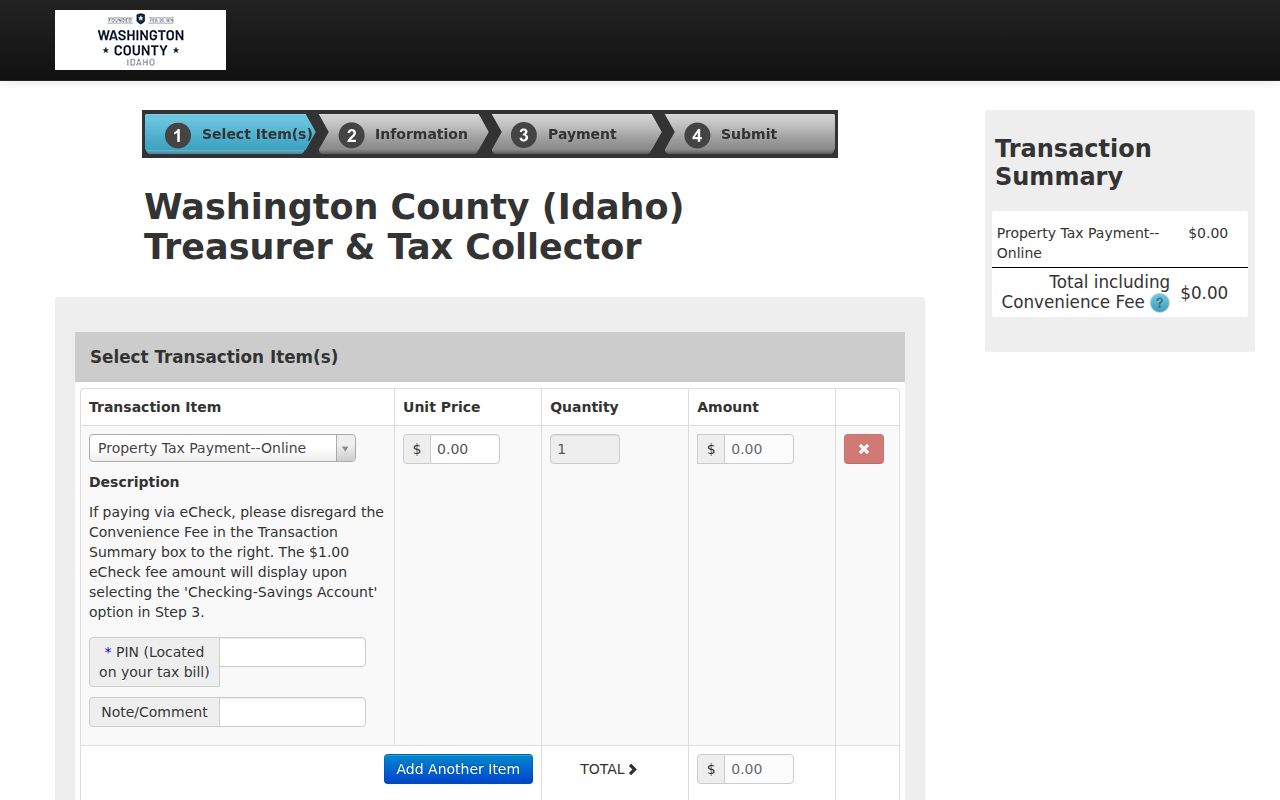
The PIN covers payment; balances belong with the Treasurer.
Follow a Washington County Bill from Parcel to Payment
Start from the address or mapped parcel. From there, secure the PIN, keep Assessor value distinct from Treasurer billing, and confirm status directly with the tax collector.
- Locate the parcel and obtain the PIN from the tax bill or county office
- Use the PIN in the Treasurer payment portal and verify status with the office
- Confirm taxable value and exemptions with the Assessor
- Ask the Treasurer about delinquency or pending proceedings
- Assessed value
- The value basis used before applicable exemptions.
- Mill rate / levy
- The rate applied by relevant taxing jurisdictions.
- Homestead exemption
- Qualifying reduction in taxable value for a primary residence.
- Tax lien
- Statutory claim arising from unpaid property tax.
Washington County’s Two-Installment Calendar
Bills go out no later than the fourth Monday in November. For 2025, mailing occurred November 19. Installments were due December 22, 2025 and June 22, 2026. Verify the calendar each new year. A bill marked "Sent to Mortgage Company" concerns delivery only. It changes nothing in the deed or owner record.
Late Charges and Tax-Deed Proceedings
An unpaid portion draws a 2 percent late charge after 5 p.m. on the due date. Interest then accrues daily at 1 percent per month on the delinquent tax and the charge. Proceedings for delinquent 2022 taxes began January 2, 2026. A notice alone proves no completed transfer. A July 2025 auction record names 1023 State Street, PIN RPW0400014007A, Lots 7 and 8, Block 14, Fruitvale Addition. Commissioner minutes and notices add description and sale context. The payment page cannot supply that.
Homeowner and Property Tax Reduction Programs
Idaho's April 2026 guidance sets the homeowner's exemption at 50 percent of value, capped at $125,000. Primary-dwelling, one-acre, ownership, and timing rules all apply. Trust, LLC, and life-estate arrangements need careful eligibility review. Property Tax Reduction is an annual April 15 application. File locally through the Washington County Assessor and check current statewide rules with the Idaho State Tax Commission. Approval changes taxable value, not the Recorder's ownership chain.
District Maps Explain Different Levy Combinations
Washington County publishes separate maps for cities, schools, voting, fire, ambulance, water, irrigation, drainage, roads, and impact areas. Nearby parcels can fall into different levy combinations. Neighbors can share a mailing city yet differ. Explore the county map catalog for geography, then verify actual levies on the tax record itself.
Ask the Correct Washington County Office
Start with the right office. The Assessor, at 485 E 3rd Street in Weiser, handles parcel identity, market value, taxable value, and exemption questions. The Treasurer, at 256 E Court Street, takes bills, payments, delinquency, and tax-deed administration. A vendor screen replaces neither record. Bring the PIN, situs address, owner mailing information, tax year, and a copy of the notice or bill. Those details speed reconciliation. When a record has no public interface, request inspection or copies with a narrow description. The county public-record form asks for inspection or copies and includes contact and signature fields. Idaho Public Records Act timing and actual-cost rules apply. A precise inquiry to the creating office works fastest. Name the parcel and the tax year.
Read Tax Notices Without Assuming Ownership
Tax notices document administration, not ownership. Tax-deed notices, delinquency letters, payment records, and "Sent to Mortgage Company" language all show how the tax side runs. None of them shows current occupancy. A mortgage servicer may receive or pay a bill while the owner stays the grantee shown in land records. Publication of tax-deed proceedings marks a statutory stage, not a finished sale. For purchase diligence, pair the Treasurer's status with the Assessor's parcel identity and the Recorder's deed index. Disputed balance? Get a current statement from the Treasurer. Disputed value? Preserve the assessment notice and use the appeal route. Keeping these functions separate stops a payment screen from passing as a full Washington County property tax history.
Assemble Evidence Before the June Review
A strong appeal targets the January 1 value the Assessor set. Check the notice against the parcel itself. Size, improvements, condition, and use should all match. When something is off, that is your starting point. Bring dated photographs, measurements, repair records, and comparable sales. Add enough detail to explain why each one matters. A neighbor's smaller tax bill is not evidence of anything. It may reflect a different exemption or levy mix rather than a lower market value.
Talk with the Assessor before you file anything. Fixing a clerical parcel fact and contesting a valuation are two separate tasks. Keep copies of the notice, your evidence, the filing date, and any written reply. If the Board of Equalization decision still seems wrong, follow the current Idaho instructions. They cover the next review level and its deadline. The original filing does not carry forward on its own.
Exemptions run on their own proof and calendar. The homeowner's exemption is not automatic for residential parcels. The annual Property Tax Reduction program is not either. Occupancy, ownership form, acreage, income or status criteria, and filing timing all need verification. Verify each one under the current program. Remember that an approved exemption changes taxable value. The assessed market value may still appear as a separate figure.
Appeal a Washington County Assessment on Time
Read the notice right away. Start by raising factual errors or valuation evidence with the Assessor directly. Idaho's ordinary county Board of Equalization deadline falls on the fourth Monday in June. The calendar matters here. Comparable sales, photographs, measurements, and condition evidence all carry weight. Corrected parcel characteristics help too. These carry more weight than tax bill comparisons ever will. Further state-board or court review follows separate procedures of its own.
The State Tax Commission explanation lays out the appeal sequence. Confirm current dates locally. Missing a statutory filing date can end that cycle's review entirely.
Appeal window. File with the Washington County Board of Equalization by the applicable fourth-Monday-in-June deadline after first reviewing the notice with the Assessor.